

Case Study on Apple’s Business Strategies
Apple was founded by Steve Jobs and Stephen Wozniak in 1976; Apple Computers revolutionized the personal computer industry. It brought about different changes to the industry; these changes are still visible in the present. The company’s products were used as a basis by other computer company’s in designing the specifications and physical characteristics of their product. It also serves as a meter of how products are designed. The company offers various products for the different market it targets. The products made by the company offer something different.
We can describe Apple’s business strategy in terms of product differentiation and stratigcs alliances
Product Differentiation
Apple prides itself on its innovation. When reviewing the history of Apple, it is evident that this attitude permeated the company during its peaks of success. For instance, Apple pioneered the PDA market by introducing the Newton in 1993. Later, Apple introduced the easy-to-use iMac in 1998, and updates following 1998. It released a highly stable operating system in 1999, and updates following 1999. Apple had one of its critical points in history in 1999 when it introduced the iBook. This completed their “product matrix”, a simplified product mix strategy formulated by Jobs. This move allowed Apple to have a desktop and a portable computer in both the professional and the consumer segments.
A company attempts to make its strategy a. For this to occur, a product differentiation strategy that is economically valuable must also be rare, difficult to imitate, and the company must have the organization to exploit this. If there are fewer firms differentiating than the number required for perfect competition dynamics, the strategy is rare. If there is no direct, easy duplication and there are no easy substitutes, the strategy is difficult to imitate.
There are four primary organizing dilemmas when considering product differentiation as a strategy. They are as depicted below.
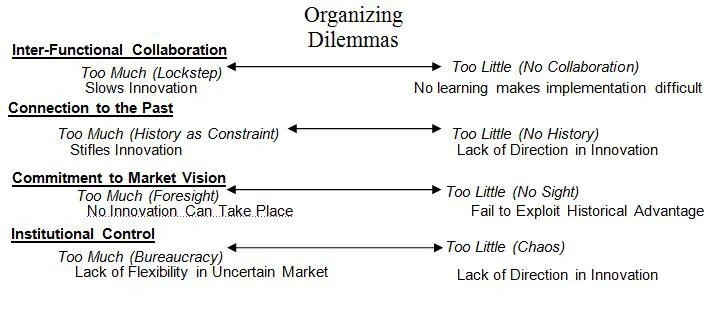 To resolve these dilemmas, there must be an appropriate organization structure. A U-Form organization resolves the inter-functional collaboration dilemma if there are product development and product management teams. Combining the old with the new resolves the connection to the past dilemma. Having a policy of experimentation and a tolerance for failure resolves the commitment to market vision dilemma. Managerial freedom within broad decision-making guidelines will resolve the institutional control dilemma.
Strategic Alliances
Apple has a history of shunning strategic alliances. On June 25, 1985, Bill Gates sent a memo to John Sculley (then-CEO of Apple) and Jean-Louis Gassee (then-Products President). Gates recommended that Apple license Macintosh technology to 3-5 significant manufacturers, listing companies and contacts such as AT&T, DEC, Texas Instruments, and Motorola. (Linzmayer, 245-8) After not receiving a response, Gates wrote another memo on July 29, naming three other companies and stating, “I want to help in any way I can with the licensing. Please give me a call.” In 1987, Sculley refused to sign licensing contracts with Apollo Computer. He felt that up-and-coming rival would overtake Apollo Computer, which did happen.
Then, Sculley and Michael Spindler (COO) partnered Apple with IBM and Motorola on the PowerPC chip. Sculley and Spindler were hoping IBM would buy Apple and put them in charge of the PC business. That never came to fruition, because Apple (with Spindler as the CEO) seemed contradictory and was extraordinarily difficult in business dealings. Apple turned the corner in 1993. Spindler begrudgingly licensed the Mac to Power Computing in 1993 and to Radius (who made Mac monitors) in 1995. However, Spindler nixed Gateway in 1995 due to cannibalization fears. Gil Amelio, an avid supporter of licensing, took over as CEO in 1996. Under Amelio, Apple licensed to Motorola and IBM. In 1996, Apple announced the $427 million purchase of NeXT Software, marking the return of Steve Jobs. Amelio suddenly resigned in 1997, and the stage was set for Jobs to resume power.
Jobs despised licensing, calling cloners “leeches”. He pulled the plug, essentially killing its largest licensee (Power Computing). Apple subsequently acquired Power Computing’s customer database, Mac OS license, and key employees for $100 million of Apple stock and $10 million to cover debt and closing costs. The business was worth $400 million.
A massive reversal occurred in 1997 and 1998. In 1997, Jobs overhauled the board of directors and then entered Apple into patent cross-licensing and technology agreements with Microsoft. In 1998, Jobs stated that Apple’s strategy is to “focus all of our software development resources on extending the Macintosh operating system. To realize our ambitious plans we must focus all of our efforts in one direction.” This statement was in the wake of Apple divesting significant software holdings (Claris/FileMaker and Newton).
There is economic value in strategic alliances. In the case of Apple, there was the opportunity to manage risk and share costs facilitate tacit collusion , and manage uncertainty. It would have been applicable to the industries in which Apple operated. Tacit collusion is a valid source of economic value in network industries, which the computer industry is. Managing uncertainty, managing risk, and sharing costs are sources of economic value in any industry. Although Apple eventually realized the economic value of strategic alliances, it should have occurred earlier.
A strategic alliance can be a sustained competitive advantage if it is rare, difficult to imitate, and the company has an organization to exploit it. If the number of competing firms implementing a similar strategic alliance is relatively few, the strategy is rare. If there are socially complex relations among partners and there is no direct duplication, the strategy is difficult to imitate. When organizing for strategic alliances, a firm must consider whether the alliance is non-equity or equity. A non-equity alliance should have explicit contracts and legal sanctions. An equity alliance should have contracts describing the equity investment. There are some substitutes for an equity alliance, such as internal development and acquisitions. However, the difficulties with these drive the formation of strategic alliances. It is vital to remember, “Commitment, coordination, and trust are all.
Greetings ~ Santhil


Social Plugin